
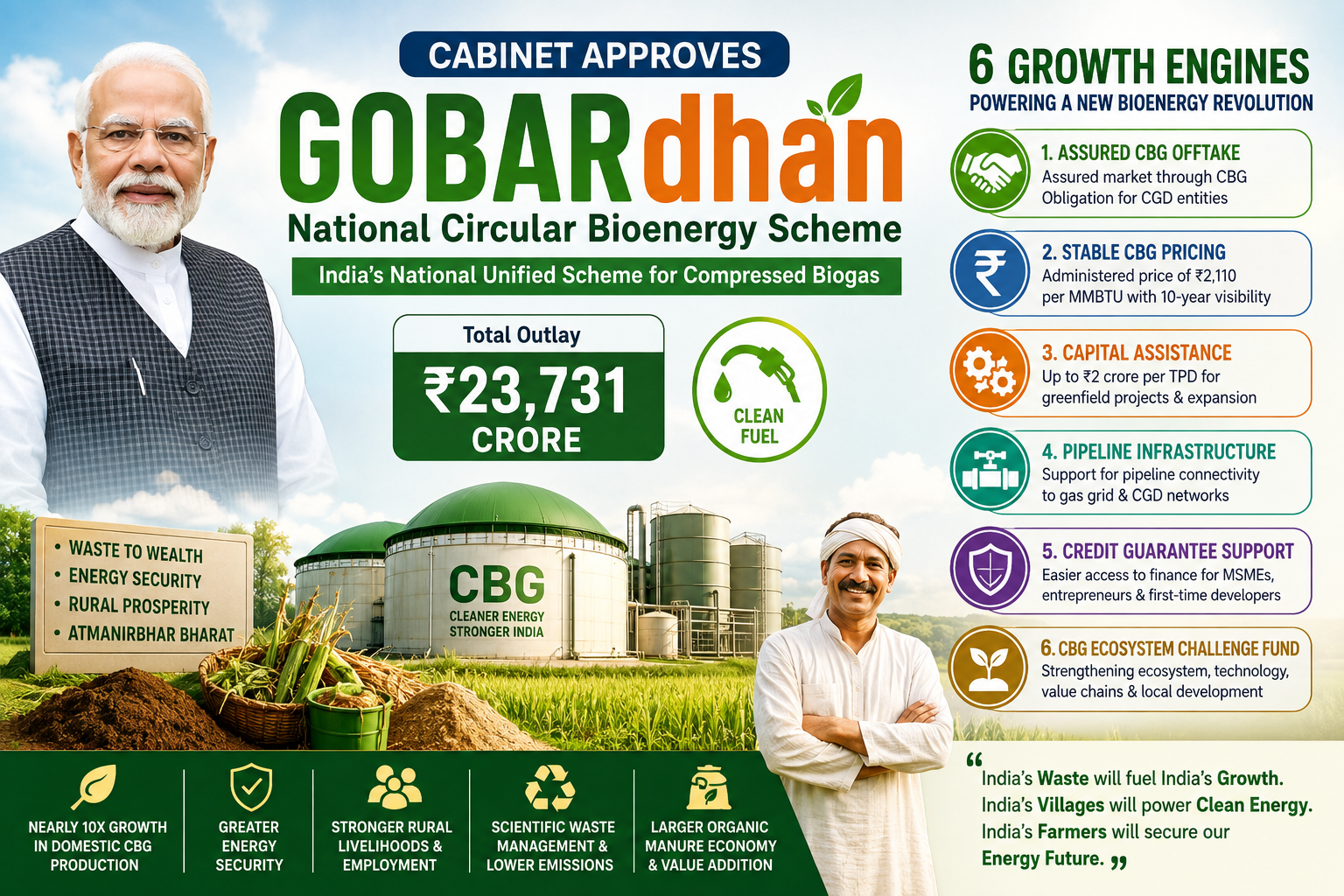
GOBARdhan Scheme 2026: Government Approves ₹23,731 Crore National CBG Scheme | Complete Guide to CBG Subsidy, Pricing & Benefits
GOBARdhan Scheme 2026: Complete Guide to CBG Subsidy, Pricing, Offtake, Pipeline & Credit Guarantee
Important Update – 21st August 2026
This article was originally published on 06 August 2026 following the Union Cabinet’s approval of the GOBARdhan Scheme.
The Ministry of Petroleum and Natural Gas (MoPNG) has now issued an official Office Memorandum for implementation of the Central Sector Scheme “GOBARdhan” for development of the Compressed Biogas sector.
The Office Memorandum provides important additional clarity on:
- Capital Assistance and its ₹1.25 crore + ₹0.75 crore per TPD breakup
- CBG pricing
- CBG Affordability Support
- Pipeline infrastructure assistance
- Credit Guarantee Support
- FOM/LFOM market development
- Treatment of brownfield projects
- Municipal Solid Waste-based projects
- Existing CBG schemes such as SATAT, MNRE CFA, MDA, BAM and DPI
- Scheme implementation period
- Effective date
This article has therefore been comprehensively updated on the basis of the latest official Government framework.
GOBARdhan Scheme 2026: A Major New Framework for India’s CBG Industry
India’s Compressed Biogas industry has entered an important new phase.
The Government of India has approved the Central Sector Scheme “GOBARdhan” – Galvanizing Organic Bio-Agro Resources Dhan for development of the Compressed Biogas (CBG) sector.
The Scheme has a total stated outlay of:
₹23,731 Crore
and will be administered by the:
Ministry of Petroleum and Natural Gas – MoPNG
The overall Scheme period is:
FY 2026-27 to FY 2035-36
and the Scheme will formally come into force from:
1 September 2026
What makes GOBARdhan particularly important is that it is not merely a capital subsidy scheme.
It attempts to address almost the complete CBG value chain through:
- CBG Offtake Assurance
- Stable CBG Pricing
- Capital Assistance
- Pipeline Infrastructure
- Credit Guarantee Support
- CBG Ecosystem Development
In simple terms, the Government is addressing some of the most important questions faced by every CBG investor:
Who will buy the gas?
At what price will CBG be sold?
How much capital assistance may be available?
How will the plant connect to CGD or trunk gas pipelines?
How can MSME CBG projects get better access to bank finance?
What will happen to FOM/LFOM generated by the plant?
This integrated approach makes GOBARdhan one of the most significant policy developments for India’s CBG sector.
GOBARdhan Scheme 2026 – Key Benefits at a Glance
| Particular | Official Framework |
|---|---|
| Scheme | Central Sector Scheme “GOBARdhan” |
| Full Form | Galvanizing Organic Bio-Agro Resources Dhan |
| Nodal Ministry | Ministry of Petroleum & Natural Gas |
| Total Stated Outlay | ₹23,731 Crore |
| Overall Scheme Period | FY 2026-27 to FY 2035-36 |
| Effective Date | 1 September 2026 |
| CBG Capital Assistance | Up to ₹2 Crore per TPD |
| Plant Machinery Component | ₹1.25 Crore per TPD |
| Other Eligible Infrastructure / Equipment | Up to ₹0.75 Crore per TPD |
| Initial Administered CBG Price | ₹2,110 per MMBtu |
| ACP Period | Minimum 10 Years |
| CBG Affordability Support | Capped at ₹10/kg of CBG procured, payable to Synchro Operator |
| Cluster Pipeline Support | 80% of Eligible Capital Cost |
| Standalone Pipeline Support | 50% of Eligible Capital Expenditure |
| Credit Guarantee Coverage | Up to 85% of outstanding amount at default |
| General MSME Guarantee Cap | ₹20 Crore per Project |
| Women-led MSME Guarantee Cap | ₹25 Crore per Project |
| FOM Procurement Obligation | To rise gradually from 20% to 50% through FMCs |
| Capital/Pipeline/Guarantee/Ecosystem Budget Support | Up to FY 2030-31 |
Component-Wise Financial Outlay of GOBARdhan
The Office Memorandum provides the following component-wise allocation:
| Component | Outlay |
|---|---|
| Component I – CBG Offtake Assurance Mechanism | No separate amount specified |
| Component II – CBG Affordability Support to Synchro Operator | ₹10,160 Crore |
| Component III – Capital Assistance | ₹7,063 Crore |
| Component IV – Development of Pipeline Infrastructure | ₹5,133 Crore |
| Component V – Credit Guarantee Support | ₹625 Crore |
| Component VI – CBG Ecosystem Challenge Fund | ₹500 Crore |
Important Technical Note
The Office Memorandum states the total Scheme outlay as ₹23,731 crore.
However, the numerical amounts shown against Components II to VI in the component-wise table total ₹23,481 crore, while Component I does not show a separate financial allocation.
We are reproducing the figures exactly as stated in the official Office Memorandum. Any clarification, corrigendum or treatment of the difference should be read from subsequent Government instructions, if issued.
1. CBG Offtake Assurance Mechanism
One of the biggest concerns for a CBG developer is:
“Who will buy the CBG produced by my plant?”
A technically successful CBG plant still needs a reliable and long-term market for its gas.
The Government has therefore proposed a dedicated CBG Offtake Assurance Mechanism.
MoPNG will develop an offtake framework that may include:
- Mandate to City Gas Distribution entities
- Sale to Oil Marketing Companies
- Other appropriate offtake arrangements
The objective is to create firm demand for CBG and support the notified CBG Obligation.
CBG Obligation Targets
The framework aims to achieve:
| Financial Year | CBG Obligation |
|---|---|
| FY 2026-27 | 3% |
| FY 2027-28 | 4% |
| FY 2028-29 onwards | 5% |
These obligations apply to the:
- CNG (Transport) segment
- PNG (Domestic) segment
subject to any amendments made from time to time.
Why is Assured Offtake Important for a CBG Project?
For an investor, assured demand can potentially improve:
- Revenue visibility
- Plant capacity utilisation
- Project bankability
- Lender confidence
- Financial projections
- Debt servicing capability
- Long-term investment confidence
The Office Memorandum also provides for regulatory or administrative action in case relevant entities fail to follow prescribed offtake arrangements.
Such actions may include rationalisation of APM/Non-APM gas allocation, financial disincentives or other actions separately notified by MoPNG.
This indicates that the Government intends the offtake framework to have practical enforcement support rather than remaining merely an advisory mechanism.
2. CBG Pricing Framework – ₹2,110 per MMBtu
Another major development is the introduction of an:
Administered CBG Price – ACP
The initial Administered CBG Price has been fixed at:
₹2,110 per MMBtu
The Office Memorandum specifically states that this price is:
Exclusive of applicable taxes and compression charges.
The Administered CBG Price will be payable to eligible CBG producers through a:
Designated Synchro Operator
The detailed identity, structure and operating mechanism of the Synchro Operator will be provided through the forthcoming guidelines.
Minimum 10-Year CBG Pricing Framework
The Administered CBG Price will remain in place for a:
Minimum Period of 10 Years
or later, as determined by MoPNG.
This long-term pricing framework can be extremely important for:
- Project revenue projections
- Bank loan appraisal
- Debt repayment planning
- DSCR assessment
- Project IRR
- Equity return calculations
- Financial closure
For large infrastructure projects such as CBG plants, long-term visibility of the selling price can substantially improve the quality of financial planning.
What is ₹2,110/MMBtu in ₹ per kg?
The official Office Memorandum specifies the CBG price in ₹ per MMBtu, not as one fixed official producer price in ₹ per kg.
Therefore, any conversion into ₹/kg should be treated only as an illustrative energy-equivalent calculation, because the exact conversion can depend upon:
- Calorific value of CBG
- Gas specifications
- Measurement methodology
- Applicable settlement mechanism
- Taxes
- Compression charges
- Operational guidelines
For investment and DPR purposes, it is safer to use the officially notified ₹2,110/MMBtu price and apply the relevant conversion methodology prescribed for the project.
Important: FOM and LFOM Are Linked with the Pricing Framework
The Office Memorandum makes an important connection between the CBG price framework and the by-products generated by the CBG plant.
The Administered CBG Price includes an incentive component relating to the sale of by-products, including:
- FOM – Fermented Organic Manure
- LFOM – Liquid Fermented Organic Manure
The responsibility for:
- Sale of by-products
- Proper utilisation
- Beneficial utilisation
will remain with the CBG producer in order to continue receiving support.
This means that CBG developers should not treat FOM and LFOM merely as waste-disposal issues.
A serious CBG business model should include a complete strategy for:
Production → Processing → Storage → Value Addition → Marketing → Distribution → Sale of FOM/LFOM
CBG Affordability Support – Up to ₹10 per kg
The Government has also created a separate:
CBG Affordability Support Mechanism
Under the Office Memorandum, Government support to the Synchro Operator will be capped at:
₹10 per kg of CBG procured
The affordability support will remain in place for the ten-year period:
FY 2026-27 to FY 2035-36
Very Important Clarification
This ₹10/kg should not automatically be interpreted as an additional ₹10/kg subsidy directly payable to every CBG producer.
The Office Memorandum specifically describes this as:
Affordability Support to the Synchro Operator.
The exact commercial mechanism, settlement process and relationship between the Synchro Operator and eligible CBG producer will be understood only after detailed operational guidelines are issued.
3. Capital Assistance – Up to ₹2 Crore per TPD
The capital-assistance component is likely to be one of the most important parts of GOBARdhan for CBG investors.
Financial support will be provided for:
- Establishment of CBG plants
- Feedstock aggregation infrastructure
- Organic manure processing
- Value addition machinery
- Other eligible equipment
For eligible Greenfield CBG Projects, assistance can be provided at:
Up to ₹2 Crore per TPD of CBG Capacity
The latest Office Memorandum now provides a clear breakup of this amount.
Breakup of ₹2 Crore per TPD Capital Assistance
A. Plant Machinery
Capital assistance includes:
₹1.25 Crore per TPD
for eligible plant machinery.
B. Feedstock & Manure-Related Infrastructure
Additionally, assistance of up to:
₹0.75 Crore per TPD
may be available for eligible:
- Feedstock aggregation
- Organic manure processing
- Value addition machinery
- Other eligible equipment
Therefore:
₹1.25 Crore/TPD + ₹0.75 Crore/TPD
=
Up to ₹2 Crore per TPD
This distinction is extremely important.
The entire ₹2 crore/TPD should not be understood as assistance exclusively for core CBG plant machinery.
Illustrative Capital Assistance Calculation
The following examples are only to explain the capacity-based ceiling.
| CBG Capacity | Plant Machinery @ ₹1.25 Cr/TPD | Other Eligible Assets @ ₹0.75 Cr/TPD | Overall Headline Ceiling |
|---|---|---|---|
| 2 TPD | ₹2.50 Cr | Up to ₹1.50 Cr | Up to ₹4 Cr |
| 5 TPD | ₹6.25 Cr | Up to ₹3.75 Cr | Up to ₹10 Cr |
| 10 TPD | ₹12.50 Cr | Up to ₹7.50 Cr | Up to ₹20 Cr |
| 12 TPD | ₹15.00 Cr | Up to ₹9.00 Cr | Up to ₹24 Cr |
| 15 TPD | ₹18.75 Cr | Up to ₹11.25 Cr | Up to ₹30 Cr |
| 20 TPD | ₹25.00 Cr | Up to ₹15.00 Cr | Up to ₹40 Cr |
Important
These are capacity-based maximum illustrative calculations, not sanctioned subsidy amounts.
The actual assistance for any project will depend upon:
- Project eligibility
- Eligible capital expenditure
- Eligible machinery
- Installed CBG capacity
- Project category
- Investment timing
- Documentation
- Compliance with scheme conditions
- Approval by the competent authority
- Operational guidelines yet to be issued
Therefore:
“Up to ₹2 Crore per TPD” is a maximum assistance framework, not an automatic entitlement.
Are Brownfield CBG Projects Eligible?
Yes, but with an important condition.
The Office Memorandum states that:
Brownfield Projects will be eligible for CAPEX support only for additional CBG capacity.
In simple words:
If an existing CBG plant increases its installed production capacity, the eligible capital assistance will relate to the additional capacity created.
The existing installed capacity should not automatically be used for calculating fresh assistance.
Detailed calculation and eligibility conditions will be known after operational guidelines are issued.
Extra Capital Assistance for Special Category Areas
The scheme provides additional support to projects located in specified Special Category Areas.
These include:
- Northeastern States
- Sikkim
- Uttarakhand
- Himachal Pradesh
- Jammu & Kashmir
- Ladakh
- Lakshadweep
- Andaman & Nicobar Islands
Eligible projects in these areas will receive:
Additional Capital Support of 20%
over the assistance available for plant machinery.
Important
The additional 20% is linked specifically with plant machinery assistance.
It should not be calculated as 20% additional assistance on the entire cost of the CBG project.
Important Exclusion for Municipal Solid Waste-Based CBG Projects
One of the most important eligibility provisions in the Office Memorandum relates to Municipal Solid Waste.
It specifically states that:
CBG projects predominantly based on Municipal Solid Waste shall not be eligible for Capital Assistance and Credit Guarantee Support under this Scheme.
This distinction is important for developers planning MSW-based CBG projects.
The exclusion stated in the Office Memorandum specifically relates to:
- Capital Assistance
- Credit Guarantee Support
Developers of MSW-dominant projects should therefore carefully review the component-wise operational guidelines before deciding what other parts of GOBARdhan may or may not apply to them.
4. Development of Pipeline Infrastructure
CBG evacuation is another major challenge for projects.
A plant may produce good-quality gas, but if the nearest market or CGD network is far away, cascade transportation and logistics can significantly affect economics.
GOBARdhan therefore includes financial assistance for pipeline infrastructure.
The Scheme provides two broad categories.
Category 1: Cluster-Based Pipeline Infrastructure
Where CBG plants are connected through cluster-based infrastructure to a trunk gas pipeline, the Scheme provides support for:
Up to 75 Weighted Kilometres per CBG Plant
at:
80% of Eligible Capital Cost
The assistance will be provided to the infrastructure developer, which according to the Office Memorandum would usually be the trunk pipeline owner.
Important
This means the 80% assistance should not automatically be treated as a direct subsidy paid to the CBG plant owner.
It is support for the eligible pipeline infrastructure through the eligible infrastructure developer.
Category 2: Standalone CBG Plant Pipeline Connectivity
For a standalone CBG plant connecting to:
- Nearest CGD Network, or
- CGD Retail Outlet
financial assistance may be provided for a distance of:
Up to 75 km
at:
50% of Eligible Capital Expenditure
to the developer of the pipeline infrastructure.
Why Pipeline Support is Important
Pipeline connectivity can potentially help CBG projects by:
- Reducing dependency on cascade transportation
- Reducing logistics complexity
- Improving gas evacuation
- Improving reliability
- Connecting plants directly with gas markets
- Supporting better capacity utilisation
- Improving long-term project economics
Actual project-level eligibility will depend on the operational guidelines.
5. Credit Guarantee Support for MSME CBG Projects
Access to institutional finance has been one of the most important challenges faced by CBG developers.
Banks evaluate CBG projects on several risks, including:
- Feedstock risk
- Technology risk
- Offtake risk
- Construction risk
- Operating risk
- Promoter strength
- Project cash flow
- Collateral availability
To improve access to institutional finance, GOBARdhan provides a dedicated:
Credit Guarantee Mechanism
for eligible CBG projects set up by:
Micro, Small and Medium Enterprises – MSMEs
How Much Credit Guarantee is Available?
Credit guarantee coverage can extend up to:
85% of the Outstanding Amount at Default
subject to project-level maximum caps.
General MSME CBG Projects
Maximum guarantee cap:
₹20 Crore per Project
Women-Led MSME CBG Projects
Maximum guarantee cap:
₹25 Crore per Project
This additional ceiling for women-led MSME projects is an important feature of the Scheme.
Does 85% Credit Guarantee Mean 85% Loan Subsidy?
No.
This is a critical distinction.
Credit Guarantee is not a capital subsidy.
It is also not an upfront payment equal to 85% of the loan.
The mechanism provides guarantee coverage of up to 85% of the outstanding amount at default, subject to the specified caps.
Its purpose is to reduce a portion of the lender’s credit risk and thereby support institutional financing for eligible projects.
Does Credit Guarantee Mean the Bank Must Sanction the Loan?
Again, no.
Banks and financial institutions will still evaluate:
- Promoter background
- Promoter contribution
- Cost of project
- Means of finance
- Feedstock availability
- Feedstock agreements
- Technology
- EPC arrangement
- CBG production assumptions
- Offtake
- Revenue assumptions
- FOM/LFOM revenue
- Working capital
- DSCR
- IRR
- Repayment capacity
- Statutory approvals
- Overall project viability
Therefore, Feasibility Study, DPR and proper Financial Modelling remain extremely important even when credit guarantee support is available.
6. CBG Ecosystem Challenge Fund
GOBARdhan allocates:
₹500 Crore
towards the:
CBG Ecosystem Challenge Fund
This is an important component because India’s CBG sector cannot scale only by funding individual plants.
The surrounding ecosystem must also develop.
The Fund can support areas such as:
- Development of domestic CBG equipment
- Process improvement
- Yield improvement
- FOM/LFOM value addition
- Feedstock resource assessment
- Feedstock mapping
- Feedstock aggregation infrastructure
- Supporting infrastructure
- District-level CBG development plans
- Capacity building
- Stakeholder awareness
- Stakeholder mobilisation
- Other ecosystem-development activities
The Government also proposes to encourage competition among district administrations for CBG-sector development.
This can help create stronger local CBG clusters in districts having good feedstock potential.
Major New Development for FOM and LFOM
A successful CBG project does not produce only gas.
It also produces large quantities of digestate that need to be converted, processed or utilised appropriately as organic manure products.
The new GOBARdhan framework gives significantly greater attention to:
- FOM
- LFOM
- PROM
This is important because the manure side of a CBG plant can materially affect:
- Plant operations
- Storage requirements
- Working capital
- Logistics
- Revenue
- Overall project viability
Department of Fertilizers to Develop the FOM/LFOM Market
The Department of Fertilizers – DoF will act as the nodal agency for:
- Demand creation
- Market development
- Marketing
- Value addition
- Branding
- Distribution
- Adoption
of:
FOM – Fermented Organic Manure
LFOM – Liquid Fermented Organic Manure
and
PROM – Phosphate Rich Organic Manure
generated from CBG plants.
The Government intends to develop these markets through:
- Fertilizer Marketing Companies
- Cooperatives
- Other relevant channels
This is a significant move towards treating the fertilizer output of a CBG project as a structured part of the overall business model.
Fertilizer Marketing Companies to Procure FOM
The Department of Fertilizers will mandate Fertilizer Marketing Companies to procure FOM produced by CBG plants under GOBARdhan.
The procurement obligation is proposed to rise in a graded manner from:
20% to 50%
Detailed guidelines will determine how this obligation will be implemented and enforced.
The Department of Fertilizers will also work towards development of:
- FOM aggregation infrastructure
- LFOM aggregation infrastructure
- Storage infrastructure
at suitable Fertilizer Marketing Company depots.
Important
The Office Memorandum does not provide the year-wise progression from 20% to 50%.
Therefore, investors should wait for the detailed guidelines before using a particular procurement percentage in financial projections.
Regulatory Relief for FOM/LFOM Manufacturers
The Department of Agriculture & Farmers’ Welfare – DoA&FW will extend exemption from authorization-letter requirements for sales by FOM/LFOM manufacturers up to:
End of FY 2035-36
The objective is to reduce regulatory barriers to commercialisation of organic manure generated by CBG projects.
Carbon Credits for CBG Projects
Another important long-term opportunity is carbon credits.
The Ministry of Power has been assigned responsibility to:
- Explore utilisation of CBG plant by-products towards applicable co-firing mandates after suitable research and development; and
- Through the Bureau of Energy Efficiency – BEE, publish methodology for CBG production projects under the:
Offset Mechanism of the Carbon Credit Trading Scheme – CCTS
This could create an additional opportunity for eligible CBG projects.
However:
Carbon Credit Revenue should not yet be treated as guaranteed project income.
The applicable methodology, eligibility, monitoring requirements, verification mechanism and credit generation process will need to be understood after they are officially notified.
What Happens to Existing CBG Schemes such as SATAT and MNRE CFA?
This is another major provision that existing developers should understand carefully.
After GOBARdhan comes into force, existing CBG-related schemes and interventions having significant overlap in intended outcomes may be:
Subsumed or Rationalised
The Office Memorandum specifically mentions:
1. Market Development Assistance – MDA
Administered by the Department of Fertilizers
2. Central Financial Assistance for CBG Plants under Waste to Energy Programme
Administered by the Ministry of New and Renewable Energy – MNRE
3. Biomass Aggregation Machinery Scheme
Administered by MoPNG
4. Development of Pipeline Infrastructure Scheme
Administered by MoPNG
5. SATAT Initiative
Administered by MoPNG
Does This Mean All Existing Schemes Have Stopped Immediately?
No.
This is an extremely important clarification.
The Office Memorandum says these schemes will be subsumed or rationalised:
“to the extent and from the date specified in the relevant operational guidelines.”
Therefore, developers should not assume that every existing scheme has automatically stopped immediately.
Projects having:
- Existing registrations
- Applications
- Sanctions
- LOIs
- Approvals
- Claims
- Projects under construction
should study the transition provisions that will be issued in the relevant operational guidelines.
Overall Scheme is 10 Years, But Some Financial Support is for First 5 Years
This provision deserves special attention.
The overall GOBARdhan Scheme period is:
FY 2026-27 to FY 2035-36
However, budgetary support for the following components will be implemented during the first five years, up to:
FY 2030-31
These components are:
- Capital Assistance
- Development of Pipeline Infrastructure
- Credit Guarantee Support
- CBG Ecosystem Challenge Fund
Therefore:
Overall Scheme Horizon
FY 2026-27 to FY 2035-36
Capital/Pipeline/Credit Guarantee/Ecosystem Budget Support
Up to FY 2030-31
CBG Affordability Support
FY 2026-27 to FY 2035-36
This distinction is very important when planning the implementation timeline of a new CBG project.
When Will the GOBARdhan Scheme Become Effective?
The Office Memorandum clearly states:
The Scheme shall come into force from 1 September 2026.
However, this should not be confused with the opening of an application portal.
MoPNG will separately issue:
- Component-wise Operational Guidelines
- Standard Operating Procedures – SOPs
- Application Formats
- Contractual Frameworks
- Other Implementation Instructions
Can We Apply for GOBARdhan Subsidy Immediately?
At present, the Office Memorandum establishes the overall framework.
The detailed application procedure is to be issued separately by MoPNG.
Therefore, the following should not yet be assumed unless prescribed in subsequent guidelines:
- Application portal
- Application form
- Detailed eligibility criteria
- Required documents
- Cut-off dates
- Application timeline
- Project commencement conditions
- Eligible expenditure dates
- Approval process
- Disbursement milestones
- Claim procedure
- Inspection procedure
- Treatment of projects already under implementation
- Detailed brownfield calculation
- Detailed Synchro Operator process
Adroit Corporation recommends that developers do not make irreversible investment or subsidy assumptions merely on the basis of the headline capital-assistance ceiling.
Detailed eligibility should be checked once the operational guidelines are notified.
Who Will Approve and Monitor Projects?
GOBARdhan will be administered by MoPNG through a structured institutional system involving:
- Steering Committee – SC
- Project Approval Board – PAB
- Project Appraisal Committee – PAC
- Project Management Agency – PMA
- Petroleum Planning & Analysis Cell – PPAC
These bodies will support:
- Implementation
- Project appraisal
- Project approval
- Monitoring
- Pricing notification
- Reporting
This demonstrates that the Government intends to establish a formal institutional framework for implementation and monitoring of the Scheme.
Which Feedstocks Can be Used for CBG?
CBG can be produced from several organic feedstocks depending upon technical suitability and project configuration, including:
- Agricultural residue
- Cattle dung
- Press mud
- Organic biomass
- Other suitable biodegradable feedstocks
Projects must undertake a proper feedstock study before selecting capacity.
Special Caution for MSW
As explained above, projects predominantly based on Municipal Solid Waste are specifically excluded from:
- Capital Assistance
- Credit Guarantee Support
under this Scheme.
Therefore, the feedstock mix of a project can directly affect scheme eligibility.
Why Feedstock Assessment is More Important Than Subsidy
For a CBG investor, the first question should not be:
“How much subsidy will I get?”
The first question should be:
“Can I sustainably operate this plant for the next 10–15 years?”
A proper feedstock feasibility study should examine:
- Feedstock type
- Feedstock availability
- Seasonal variation
- Catchment radius
- Cost per tonne
- Transportation cost
- Storage requirement
- Dry matter
- Organic matter
- Biogas yield
- Methane yield
- Competing uses
- Long-term procurement arrangement
- Escalation in feedstock prices
A project with attractive subsidy but weak feedstock security can still face serious operational problems.
What Should a CBG Investor Study Before Setting Up a Plant?
Government support can improve project economics, but subsidy should support a viable project, not replace project viability.
Before investing, developers should evaluate the following.
1. Feedstock Availability
Determine:
- Type
- Quantity
- Seasonality
- Cost
- Collection radius
- Long-term availability
2. Feedstock Quality & Gas Yield
Different feedstocks have different:
- Total solids
- Volatile solids
- Biogas potential
- Methane percentage
- Retention requirements
Project capacity should therefore be based on realistic gas-yield assumptions.
3. Technology Selection
Technology should be selected according to:
- Feedstock
- Solid content
- Digestion process
- Retention time
- Temperature
- Mixing requirements
- Operating conditions
- Capacity
4. Project Location
Location should be evaluated based on:
- Feedstock catchment
- Road connectivity
- Water
- Electricity
- CGD proximity
- Gas evacuation
- Land
- Environmental considerations
- FOM/LFOM market
5. CBG Offtake
Study:
- Nearest CGD network
- Nearest CGD retail outlet
- OMC/CGD arrangement
- Pipeline possibility
- Cascade transportation
- Gas quality requirements
- Offtake terms
6. FOM/LFOM Business Model
Estimate:
- Quantity generated
- Processing requirement
- Storage requirement
- Value addition
- Packaging
- Transportation
- Market
- Realisable price
7. Project Cost
Project cost should be properly classified into:
- Land
- Site development
- Building & civil work
- Plant & machinery
- Feedstock infrastructure
- Manure-processing machinery
- Utilities
- Pipeline
- Electrical installation
- Pre-operative expenditure
- IDC
- Contingency
- Working capital
8. Means of Finance
A suitable funding structure may include:
- Promoter contribution
- Term loan
- Working capital
- Government assistance
- Other eligible incentives
9. Financial Viability
A proper financial model should examine:
- CBG revenue
- FOM/LFOM revenue
- Feedstock cost
- Electricity
- Manpower
- O&M
- Transport
- Interest
- Depreciation
- EBITDA
- DSCR
- IRR
- Break-even
- Payback
- Sensitivity analysis
Why the New GOBARdhan Scheme Can Be a Turning Point for CBG
The biggest strength of GOBARdhan is not any one subsidy amount.
Its real strength is that it attempts to address the entire CBG value chain.
A CBG project needs:
Feedstock
↓
Technology & Plant
↓
CBG Production
↓
Quality & Compression
↓
Offtake
↓
Pipeline / Transportation
↓
Revenue
and simultaneously:
Digestate
↓
FOM / LFOM Processing
↓
Storage
↓
Market & Sale
while the project also requires:
Project Finance + Working Capital + Government Support
Historically, weakness in any one of these areas could materially affect a project.
GOBARdhan attempts to strengthen multiple areas together through:
- Assured demand
- Stable pricing
- Capital assistance
- Pipeline connectivity
- Credit guarantee
- Organic manure market development
- Technology development
- Feedstock ecosystem development
That integrated approach is why the Scheme has the potential to significantly influence the growth of India’s CBG industry.
What Does GOBARdhan Mean for Banks and Financial Institutions?
The Scheme can also have an important impact on project finance.
A lender evaluating a CBG proposal typically wants comfort regarding:
- Feedstock
- Technology
- Gas yield
- Plant performance
- Offtake
- Price
- Project cost
- Promoter contribution
- Cash flow
- DSCR
- Collateral
- Government support
The combination of:
- Offtake framework
- Administered pricing
- Capital assistance
- Credit guarantee
- Pipeline connectivity
can potentially help improve project bankability.
However, these Government measures do not eliminate the need for proper bank appraisal.
A technically weak or financially unviable project may still not qualify for financing.
What Does the Scheme Mean for Farmers and Rural Areas?
CBG development can create an additional economic ecosystem around rural feedstocks such as:
- Agricultural residue
- Cattle dung
- Other organic biomass
Potential opportunities can arise in:
- Feedstock collection
- Feedstock aggregation
- Transportation
- Storage
- CBG plant employment
- Organic fertilizer processing
- FOM/LFOM distribution
Therefore, CBG development can potentially connect:
Agriculture + Waste Management + Renewable Energy + Rural Entrepreneurship
within a circular bioeconomy.
GOBARdhan Scheme 2026 – What is Confirmed and What is Still Awaited?
This is perhaps the most important section for investors.
What is Confirmed in the Office Memorandum?
The Government has confirmed the broad framework for:
- ₹23,731 Crore stated scheme outlay
- Overall Scheme period
- Effective date of 1 September 2026
- CBG Offtake Assurance Framework
- CBG Obligation trajectory
- ₹2,110/MMBtu initial ACP
- Minimum 10-year pricing framework
- Affordability support capped at ₹10/kg to Synchro Operator
- Up to ₹2 crore/TPD capital assistance
- ₹1.25 crore/TPD plant machinery component
- Up to ₹0.75 crore/TPD supporting assets
- Brownfield support for additional capacity
- Special Category Area benefit
- Pipeline infrastructure support
- Credit Guarantee framework
- MSME limits
- MSW-related exclusion
- Ecosystem Challenge Fund
- FOM/LFOM market-development framework
- Rationalisation/subsuming of overlapping schemes
- Institutional implementation mechanism
What is Still Awaited?
MoPNG still has to separately issue detailed:
- Operational Guidelines
- SOPs
- Application Formats
- Contractual Frameworks
- Implementation Instructions
Accordingly, final clarity is still required on practical matters such as:
- Exact applicant eligibility
- Project cut-off dates
- Eligible investment
- Detailed calculation methodology
- Application procedure
- Documentation
- Project appraisal
- Sanction procedure
- Disbursement mechanism
- Treatment of existing projects
- Transitional provisions
- Detailed Synchro Operator mechanism
Important Advice for CBG Investors
The new GOBARdhan Scheme is a major positive development for the CBG sector.
But investors should remember one principle:
Do not select a CBG project only because subsidy is available.
Instead:
First create a viable project.
Then:
Use Government assistance to strengthen the viable project.
The correct sequence should ideally be:
Feedstock Assessment
↓
Location & Capacity Selection
↓
Technical Feasibility
↓
Technology Selection
↓
Offtake Planning
↓
Financial Feasibility
↓
DPR
↓
Project Finance
↓
Subsidy Eligibility
↓
Implementation
↓
Claim & Disbursement
This approach can reduce project risk and improve the probability of successful implementation.
Frequently Asked Questions – GOBARdhan Scheme 2026
Q1. What is GOBARdhan Scheme 2026?
GOBARdhan is a Central Sector Scheme for development of India’s Compressed Biogas sector through CBG offtake assurance, administered pricing, capital assistance, pipeline infrastructure, credit guarantee and ecosystem support.
Q2. What is the total outlay of the GOBARdhan Scheme?
The official Office Memorandum states a total outlay of:
₹23,731 Crore
Q3. When will the GOBARdhan Scheme start?
The Scheme will come into force from:
1 September 2026
Q4. How long will the Scheme continue?
The overall Scheme will be implemented from:
FY 2026-27 to FY 2035-36.
Q5. How much CBG subsidy is available?
Eligible Greenfield CBG projects can receive capital assistance of:
Up to ₹2 Crore per TPD of CBG capacity
subject to applicable eligibility and operational guidelines.
Q6. How is ₹2 Crore per TPD divided?
The Office Memorandum provides:
₹1.25 Crore per TPD
for plant machinery
plus
Up to ₹0.75 Crore per TPD
for feedstock aggregation, organic manure processing, value-addition machinery and other eligible equipment.
Q7. Does a 10 TPD CBG plant automatically receive ₹20 crore?
No.
₹20 crore is only the headline capacity-based maximum derived from ₹2 crore × 10 TPD.
Actual assistance will depend upon eligible expenditure, project eligibility, scheme conditions, documentation and Government approval.
Q8. Are existing CBG plants eligible for capital assistance?
Brownfield projects may be eligible for capital assistance relating to additional CBG capacity.
Detailed conditions will be prescribed in operational guidelines.
Q9. What is the CBG price under GOBARdhan?
The initial Administered CBG Price is:
₹2,110 per MMBtu
exclusive of applicable taxes and compression charges.
Q10. Is ₹10/kg an additional subsidy payable directly to CBG producers?
The Office Memorandum describes the ₹10/kg cap as:
CBG Affordability Support to the Synchro Operator.
Therefore, it should not automatically be treated as a separate ₹10/kg direct subsidy payable to every CBG producer.
Q11. How long will the administered price continue?
The ACP framework is intended to remain in place for a:
Minimum period of 10 years
or later as determined by MoPNG.
Q12. Is pipeline subsidy available?
Yes.
The Scheme provides:
80% of eligible capital cost
for qualifying cluster-based pipeline infrastructure, subject to the prescribed distance framework.
For qualifying standalone CBG connectivity:
50% of eligible capital expenditure
may be supported for connection up to 75 km to the nearest CGD network or CGD retail outlet.
Q13. How much Credit Guarantee is available?
Eligible MSME CBG projects may receive guarantee coverage of up to:
85% of the outstanding amount at default
subject to maximum caps.
Q14. What is the Credit Guarantee cap?
General MSME Project:
Up to ₹20 Crore per Project
Women-Led MSME Project:
Up to ₹25 Crore per Project
Q15. Is this 85% Credit Guarantee the same as subsidy?
No.
Credit Guarantee protects a portion of the lender’s exposure in case of default. It is not an upfront capital subsidy to the project.
Q16. Are Municipal Solid Waste CBG projects eligible?
Projects predominantly based on Municipal Solid Waste are not eligible for:
- Capital Assistance
- Credit Guarantee Support
under this Scheme.
Q17. Will FOM/LFOM have an offtake mechanism?
The Department of Fertilizers will develop the market for FOM/LFOM/PROM.
Fertilizer Marketing Companies are to be mandated to procure FOM in a graded manner rising from:
20% to 50%
subject to detailed implementation guidelines.
Q18. Can CBG projects earn Carbon Credits?
The Bureau of Energy Efficiency is expected to publish a methodology for CBG-production projects under the Offset Mechanism of the Carbon Credit Trading Scheme.
Therefore, carbon-credit opportunity exists at a policy level, but detailed methodology is still awaited.
Q19. What will happen to SATAT and existing CBG subsidy schemes?
SATAT, MNRE CFA under Waste to Energy, MDA, Biomass Aggregation Machinery and existing Pipeline Infrastructure interventions may be subsumed or rationalised.
However, this will happen only:
To the extent and from the date prescribed in relevant operational guidelines.
Therefore, one should not assume that every existing scheme has immediately stopped.
Q20. Can we apply for the GOBARdhan subsidy now?
The Office Memorandum has established the framework, but MoPNG will separately issue:
- Operational Guidelines
- SOPs
- Application Formats
- Contractual Frameworks
- Implementation Instructions
The detailed application process should therefore be followed once officially notified.
How Adroit Corporation Can Help CBG Project Developers
A successful CBG project requires much more than identifying a subsidy.
At Adroit Corporation, we support CBG developers through various stages of project development, financing and Government incentive planning.
Our CBG-related advisory services include:
CBG Feasibility Study
Including assessment of:
- Feedstock
- Location
- Capacity
- Project economics
- Offtake
- Risks
- Financial viability
Detailed Project Report – DPR
Preparation of a detailed project report suitable for project planning, financing and stakeholder evaluation.
Project Finance
Support for:
- Term Loan
- Working Capital
- CMA
- Financial Modelling
- Bank Coordination
- Loan Application
- Sanction & Disbursement Coordination
Government Subsidy Consultancy
Including:
- Scheme identification
- Eligibility assessment
- Application
- Documentation
- Compliance
- Claim
- Disbursement follow-up
CBG LOI & Offtake Advisory
Support relating to CBG offtake arrangements with relevant CGD/OMC stakeholders as applicable.
Financial & Subsidy Planning
Evaluation of Central and applicable State Government incentives to develop an appropriate funding and incentive strategy for the project.
Adroit Corporation’s View on the GOBARdhan Scheme
The GOBARdhan Scheme should not be viewed only as:
“₹2 Crore per TPD Subsidy.”
The bigger opportunity is the combination of:
Assured Offtake
Stable Pricing
Capital Assistance
Pipeline Connectivity
Credit Guarantee
FOM/LFOM Market Development
Ecosystem Development
Together, these measures can address several long-standing challenges faced by India’s CBG industry.
The next crucial development will be the issuance of component-wise operational guidelines by the Ministry of Petroleum and Natural Gas.
Those guidelines will determine how the broad policy benefits translate into actual:
- Eligibility
- Applications
- Sanctions
- Contracts
- Claims
- Disbursements
for individual CBG projects.
Conclusion
The GOBARdhan Scheme 2026 represents one of the most comprehensive Government interventions for the development of India’s Compressed Biogas sector.
With a stated overall outlay of:
₹23,731 Crore
the Scheme combines:
- CBG Offtake Assurance
- ₹2,110/MMBtu Administered Pricing
- Up to ₹2 Crore/TPD Capital Assistance
- Pipeline Infrastructure Support
- Credit Guarantee Support
- FOM/LFOM Market Development
- CBG Ecosystem Challenge Fund
- Carbon Credit Framework Development
- Institutional Implementation and Monitoring
Most importantly, the Scheme recognises that CBG development requires an entire ecosystem, not merely construction of a plant.
For investors, the correct approach is therefore:
Understand the Scheme → Study the Project → Check Eligibility → Assess Viability → Arrange Finance → Apply Correctly → Implement with Compliance
Government assistance can materially improve project economics.
But the long-term success of a CBG project will ultimately depend upon:
Feedstock + Technology + Location + Offtake + Finance + FOM/LFOM + Execution
The GOBARdhan Scheme creates a strong policy foundation.
The next step is to understand and correctly implement the detailed operational guidelines as and when they are issued by the Government.
Important Disclaimer
This article is prepared for information and educational purposes based on the Government framework and Office Memorandum available as of the date of update.
The capital-assistance figures mentioned in this article represent maximum limits / ceilings prescribed in the framework and should not be treated as guaranteed subsidy sanction for any particular project.
Project-specific eligibility, eligible investment, assistance calculation, application procedure, approvals and disbursement will be governed by the detailed operational guidelines, SOPs, application formats and other instructions issued by the Government from time to time.
Investors should undertake project-specific technical, financial and subsidy-eligibility assessment before taking an investment decision.

