Pipeline Subsidy for CBG Plants under DPI Scheme for CBG–CGD Pipeline
Scheme Guidelines for Development of Pipeline Infrastructure (DPI) for the Injection of CBG into CGD Network – Complete Guide for CBG Plants
Generally we receive many inquiry about Pipeline Subsidy for CBG Plants under DPI Scheme for CBG–CGD Pipeline and about the scheme guidelines for CBG Plants and therefore this is a detail blog for you.
India is rapidly pushing towards clean energy, and Compressed Biogas (CBG) has emerged as one of the most promising green fuels under national programs such as GOBARdhan, SATAT, and MNRE’s Waste-to-Energy initiatives.
To accelerate the use of CBG, the Government of India has launched a dedicated support mechanism:
Scheme Guidelines for the Development of Pipeline Infrastructure (DPI) for the Injection of CBG in City Gas Distribution (CGD) Network.
This scheme provides financial assistance (FA) to connect CBG plants to nearby CGD networks through pipelines, ensuring full offtake and reducing transportation challenges.
This blog explains the scheme in simple language—objectives, eligibility, financial assistance, application process, timelines, and responsibilities of CBG producers and CGD entities.
1. Purpose of the DPI Scheme
According to the Ministry of Petroleum & Natural Gas (MoPNG) guidelines (June 2024), the DPI scheme aims to:
Ensure 100% offtake of CBG produced by connecting plants to CGD pipelines.
Eliminate losses and flaring of CBG due to non-availability of transport.
Promote cost-effective, environment-friendly pipeline transport instead of cylinders or tankers or CNG cascades.
Support the development of a robust regional supply network for CBG.
Reduce carbon emissions by enabling consistent gas movement from plant to consumers.
Remove financial barriers in laying MDPE/steel pipelines from CBG plant to CGD network.
2. Who Can Apply? (Eligibility Criteria)
Based on the scheme guidelines:
Eligible CBG Plants
A CBG plant can apply if:
- Installed production capacity ≥ 2 TPD.
- Plant is registered on GOBARdhan Portal.
- For preference: capacity > 5 TPD.
- Plant has a Gas Supply / Gas Transportation Agreement with CGD entity:
- Minimum 50% take-or-pay arrangement.
- Under-construction plants must have ≥25% physical progress as per DPR.
- Design and capacity of pipeline must be mutually agreed between CBG producer and CGD operator.
Eligible Beneficiary
Primary beneficiary: CGD entity laying the pipeline.
If CGD cannot lay pipeline: CBG producer may lay it and become the beneficiary.
OGMCs (Oil & Gas Marketing Companies) are not eligible.
3. Financial Assistance (Subsidy) Under DPI Scheme
Financial support is provided for building a dedicated MDPE or steel pipeline from the CBG plant to the CGD connection point.
3.1 Standard Financial Assistance (SFA)
As per scheme:
| Pipeline Segment | FA Rate |
|---|---|
| 0–50 km (Steel or MDPE) | 50% of project cost OR ₹0.5 crore per km (steel) OR ₹0.075 crore per km (MDPE), whichever is lower |
| 50–75 km | 50% of additional cost OR ₹0.15 crore per km (steel) OR ₹0.075 crore per km (MDPE), whichever is lower |
| Beyond 75 km | Not eligible for FA |
3.2 Maximum Financial Assistance
₹28.75 crore per project (upper limit).
FA applies separately for each sector if multiple CBG plants connect to one pipeline network.
4. Milestone-Based Subsidy Release
Financial assistance is released in three stages, based on certified progress:
Milestone 1 – On Approval of Application
10% of sanctioned FA (as advance)
Requires Bank Guarantee valid for 18 months.
Milestone 2 – 50% Construction Completion
Release 40% of total FA
OR50% if no advance was taken.
Milestone 3 – Completion & Commissioning
Balance 50% released after:
Commissioning report
CA-certified expenditure
Verification by PMA
Minimum 50% usage of committed gas volume for 3 months.
FA is processed by PMA → Ministry → CNA → Beneficiary’s bank account.
5. Application Process for DPI Scheme
Step 1: Submit Application
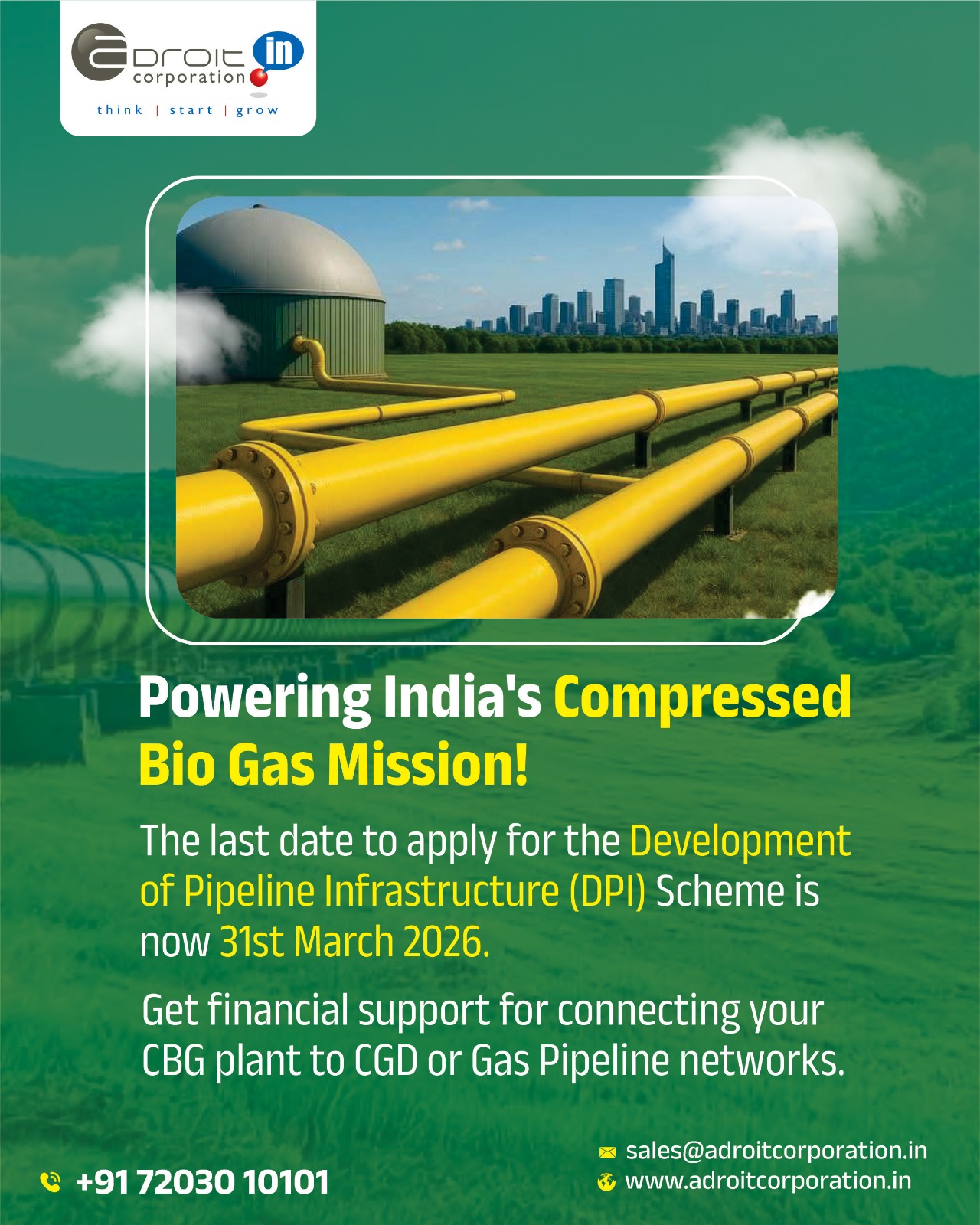
Applications must be filed through the designated portal https://dpi.eil.co.in/Default before 31st March 2026 (extended).
Incomplete applications will be rejected within 60 days.
Step 2: DPR & Technical Evaluation
DPI Scheme Last Date
PMA evaluates:
DPR details
GSA status
Plant commissioning status
Production capacity
Monetization potential
Step 3: Recommendations
PMA → PAC → PAB (final approval within 2 months).
Step 4: Post-Approval Requirements
Beneficiary must:
Obtain statutory approvals (PNGRB, local permissions).
Lay pipeline within 1 year (extension possible with justification).
Submit commissioning report + CA certificate.
PMA performs field verification.
Step 5: Release of Subsidy
Once compliance is verified, funds are released to CNA → Beneficiary (within 2 weeks).
6. Responsibilities of the Beneficiary
As per scheme:
Maintain, operate, and secure the pipeline.
Use pipeline only for biogas/CBG supply.
Follow PNGRB regulations on gas quality, pressure, odorization, and safety.
Ensure exclusivity & transportation tariff compliance.
In case of non-performance:
Warning notice → penalty → recovery of FA.
7. Technical Highlights from Scheme Diagrams
Pipeline Network Illustration:
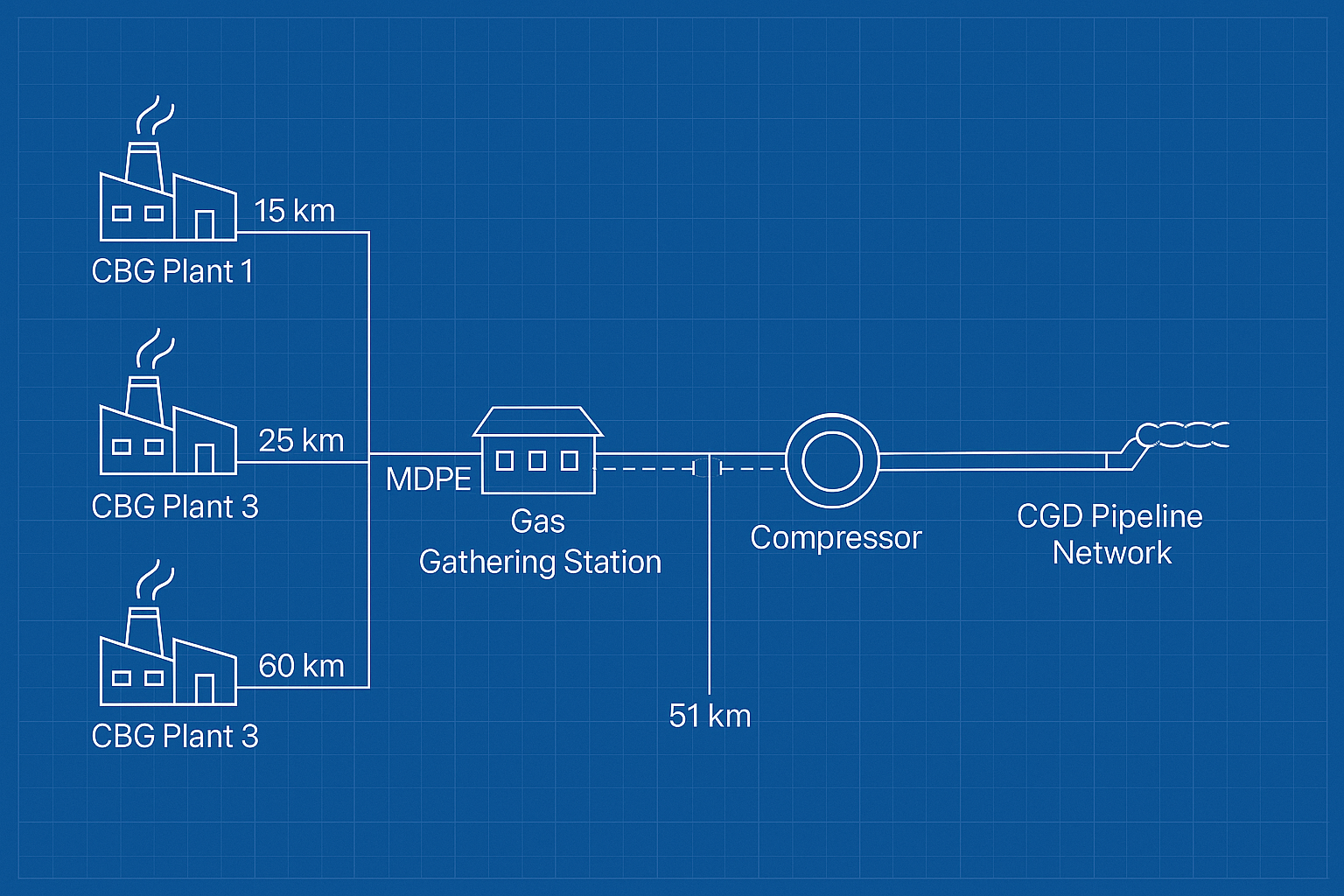
This example explains how multiple CBG plants, located at different distances, connect to a Gas Gathering Station (GGS), and then further to the City Gas Distribution (CGD) pipeline network.
Indicative Financial Assistance Calculation for Subsidy for Pipeline under DPI Scheme
Financial Assistance (FA) is calculated based on the distance of each plant from the GGS, with higher support for the first 50 km and a reduced rate for the 50–75 km segment. The illustration below explains how subsidy is computed for each plant in a simple cluster-based connectivity model. If multiple CBG plants connect to a single GGS, FA is not split but is calculated individually based on each plant’s distance.
 Example Table: Indicative Financial Assistance Calculation
 Example Table: Indicative Financial Assistance Calculation
| CBG Plant | Distance to GGS (km) | Eligible FA Rate (MDPE) | FA Calculation | Total FA (Cr) |
|---|---|---|---|---|
| Plant 1 | 15 km | ₹0.075 Cr/km | 15 × 0.075 | ₹1.125 Cr |
| Plant 2 | 25 km | ₹0.075 Cr/km | 25 × 0.075 | ₹1.875 Cr |
| Plant 3 | 60 km | 0–50 km @ ₹0.075 Cr/km | ||
| 50–60 km @ ₹0.075 Cr/km | (50 × 0.075) + (10 × 0.075) | ₹4.50 Cr |
Total Indicative FA for Cluster = ₹1.125 + ₹1.875 + ₹4.50 = ₹7.50 Cr
8. Why This Scheme Matters for CBG Project Developers
The DPI scheme solves the biggest barrier in CBG monetization:
Guaranteed evacuation of CBG
No more:
✔ Tanker dependency
✔ High logistics cost
✔ Flaring of gas
✔ Uncertain offtake
The scheme offers:
Pipeline cost subsidy up to 28.75 crore
Faster commissioning
Assured revenue via CGD agreements
Long-term confidence for investors & banks
9. Final Thoughts — Why Every CBG Plant Should Apply Before 31 March 2026
This scheme is a game-changer for India’s CBG ecosystem and Last Date to Submit Application is 31st March 2026 for Pipeline Subsidy for CBG Plants under DPI Scheme for CBG–CGD Pipeline in India.
If your CBG plant is:
2 TPD or above,
Registered on GOBARdhan,
Interested in CGD supply,
then pipeline connectivity subsidy is the fastest and most profitable way to scale your CBG business.
This scheme is available only for FY 2024-25 and 2025-26—so timely application is critical.
Want to Apply for DPI Subsidy?
As India’s leading expert in CBG project finance & subsidies, Adroit Corporation provides:
DPR
Pipeline design support
Eligibility analysis
Application filing
End-to-end support till subsidy disbursement.
Book Your Consultation:
sales@adroitcorporation.in
7203010101